
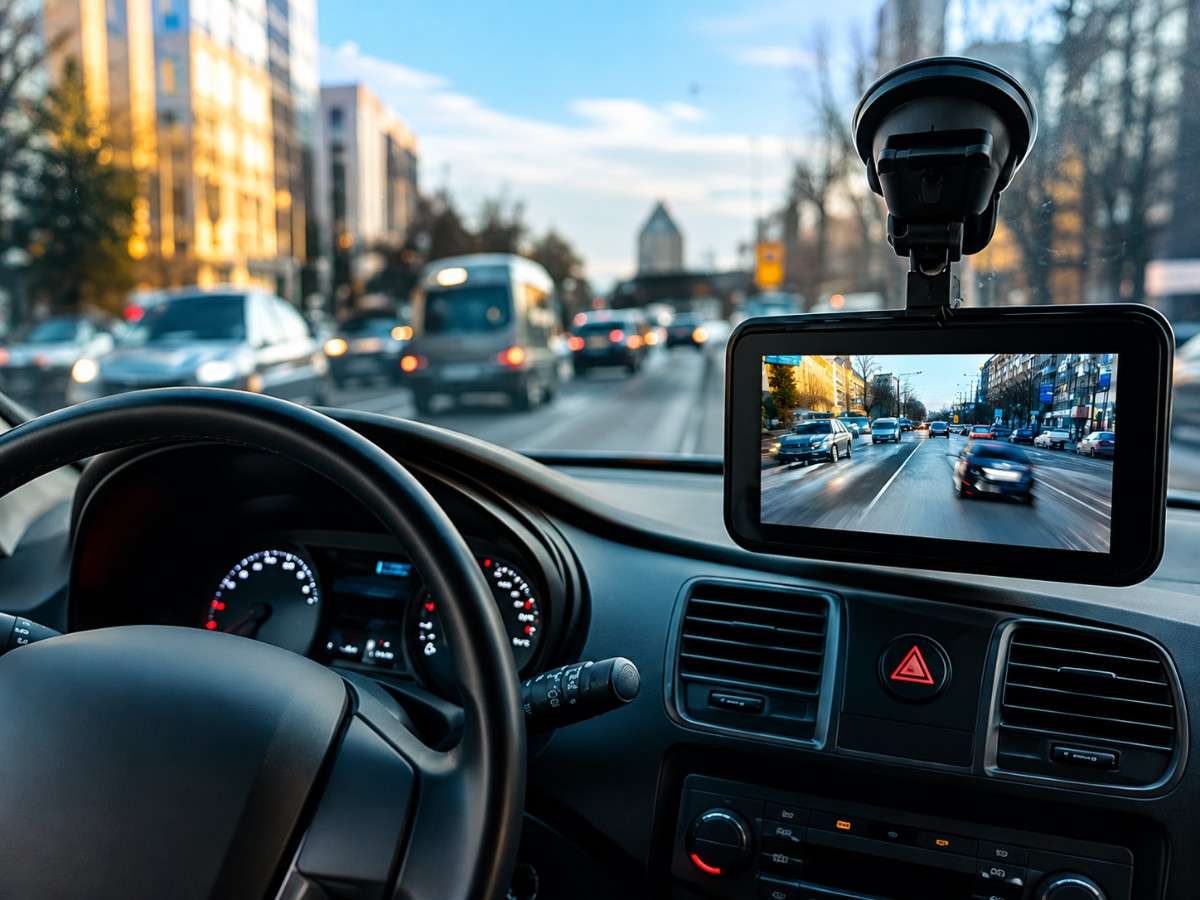
Dash cameras are a practical safety upgrade for everyday drivers, whether you commute through busy streets or travel long distances across highways. Installing a dash cam that Australian drivers trust provides valuable protection and peace of mind.
Thus, this beginner’s guide explains how the technology helps protect your vehicle on Australian roads.
How Does a Dash Cam Work?
A dash cam operates on the fundamentals of capture, process, and record, in a repeating cycle of 30-60 times per second. It is powered through the vehicle’s cigarette lighter socket, hardwired directly to the fuse box, or via an external battery pack. Here is how it works through primary components.
The Optics of the System: Lens
The process of how dash cams work starts with the light from the view entering through the fixed-focus lens of the dash cam. These lenses do not require zooming or refocusing. Generally, dash cams feature a multi-element glass lens of 6-7 layers to minimise distortion and glare. Here, the field of view (FOV) value is around 120-170 degrees.
Dash cams with a wider FOV capture a larger view, but this causes the classic issue of fisheye distortion, where objects appear farther than they are in reality. Such lenses focus light onto the image sensor directly.
The Retina of the System: Image Sensor.
To get premium video quality from the dash cam, the image sensor is the most crucial component. It is generally a CMOS (Complementary Metal-Oxide-Semiconductor) sensor. The component consists of a grid of millions of mini light-sensitive wells termed pixels. The sensor converts photons of light into electrons, sending electrical signals.
When the light from an object hits a pixel, the sensor evaluates the light colour and intensity. This results in a raw, analog electrical representation of the actual footage. The resolution of the image sensor (1080p, 1440p, and 4K) is the number of lines of pixels in the sensor's image.
But the quality of the results depends more on the physical size and low-light sensitivity than raw megapixels. Thus, a large sensor with bigger pixels is better for night-time footage recording. It prevents the black hole effect that is prominent at night.
The Brain that Makes Everything Sensible: The Processor
The raw signal from the sensor is not understandable to the dash cam memory card. It requires processing by the digital signal processor (DSP). This chip serves as the system's brain. It reads the analog signal, uses de-mosaicing action that interprets colour, adjusts white balance, and compresses data.
The processor overlays data onto the video unit, including timestamps, speed, and GPS coordinates. After processing, the system sends the video stream to the storage controller.
Other Mechanisms of Recording
The foundational function of recording is not the only mechanism of a dash cam’s operations. It involves another process called “loop recording,” which prevents the memory from filling up fast.
If you’re wondering how dash cams work in this, the system divides the dash cam’s memory card into multiple small file segments of 1, 3, or 5 minutes, where each is saved as file A, B, and C. Whenever the card memory gets filled up, the system finds the oldest file and overwrites it with the latest footage. Thus, the mechanism ensures the camera never stops recording. Disk full error is no longer a worry.
But that doesn’t imply that significant footage of accidents gets overwritten. Since dash cams feature a 3-axis accelerometer or “G-sensor”. It is a tiny chip that calculates acceleration forces.
The sensor can distinguish smooth, normal driving (low G forces) from gentle braking and deceleration. During sudden collisions or deceleration, it registers a higher G-force than the standard threshold. This triggers “Emergency Recording” mode, which labels the current video segment as “Read Only.”
What to Look for in a Dashcam?
High Resolution
Video clarity is one of the most essential dashcam features to look for. A high resolution lets you clearly spot number plates, individuals, and road signs. Details help in insurance claims and disputes. 1080p resolution is the minimum standard. Consider 4K Ultra HD for the sharpest footage.
Heat-Resistance Body
In Australia, it’s normal for the temperature inside the vehicle cabin to reach extremes during summer. Simple and inexpensive dashcams can’t keep up as their lithium-ion batteries swell and fail. Prioritise those with supercapacitors as they can handle extreme temperatures and offer long-term reliability.
Parking Mode
Your vehicle is vulnerable when you park it in busy streets or public parking areas and are away. So, when considering what to look for in a dashcam, parking mode is the next significant feature.
Parking modes, including impact recording and motion detection, document suspicious activity and external impacts in your absence.
Night Vision
If you often drive at night or in bad weather, a night-vision feature in your dash camera is helpful. Prioritise advanced night-vision sensors so you have clear, useful footage in the darkest environments when necessary.
Channel Type
Consider a single-channel dash cam unit to record only the front for minimal protection. This is ideal for limited-budget investments and those who drive on highways and empty roads.
But if you drive in urban areas through crowds, splurge a bit more for your vehicle’s safety with dual-channel setups. These offer a wider field of view and better accident documentation.
GPS Tracking
Seek integrated GPS tracking as it records your vehicle’s speed and location data. It can serve as an alibi in disputes.
Loop Recording
Consider dashcam features like loop recording next. They automatically replace old footage with the latest ones. This lets your dash cam operate continuously. No manual file management is required.
Why Australian Drivers Choose Bankstown Sound for Reliable Dash Cam Solutions
Tailored Recommendations
Every vehicle has different requirements depending on its size, parking conditions, and the driver’s driving habits. Bankstown Sound’s team evaluates every factor before suggesting a suitable dash cam solution for your specific needs.
Professional Installation
Bankstown Sound’s team offers professional dash cam installation services, including secure dash cam mounting, concealed wiring, and secure power connections for elevated performance. It minimises risks of loose wires, failed footage, and heat/vibration-induced shutdowns.
Reliable Local Support
With Bankstown Sound, you have ongoing access to local expertise for maintenance, troubleshooting support, firmware upgrades, and expansion.
Protect Your Vehicle with a Dash Cam Today
Understanding how a dash cam works helps you choose the right system for reliable protection on Australian roads. With the right features and professional installation from Bankstown Sound, a quality dash cam Australia setup ensures consistent recording, added security, and greater confidence every time you drive!